
Best Palm Trees for California Climate: Expert Buying Guide
California presents a unique horticultural challenge. From the foggy coasts of San Francisco to the scorching deserts of Palm Springs, the Golden State spans USDA hardiness zones 5b through 11a. Homeowners and landscapers often struggle to find specimens that survive—let alone thrive—in these diverse conditions. This Best Palm Trees for California Climate: Expert Buying Guide cuts through the confusion, offering professional insights into species that handle drought, humidity, and occasional frost. Whether you are designing a resort-style poolscape or a low-water front yard, selecting the right palm is critical. At Wholesale Desert Palm, we specialize in How Much Does a Palm Tree Cost in California? or cultivating hardy, climate-tested specimens that turn your landscape into a Mediterranean masterpiece without the maintenance nightmares.
Why California’s Climate Demands Specific Palm Varieties
Unlike Florida or Hawaii, California does not have a tropical monsoon climate. Most of the state relies on a Mediterranean weather pattern: wet winters followed by long, dry summers. Many exotic palms require consistent humidity and heavy rainfall—conditions California simply cannot provide without exorbitant water bills. Furthermore, the state’s soil tends to be alkaline, with high salinity in coastal and desert regions.
To succeed, a palm tree must demonstrate three core traits:
Drought tolerance (surviving summer dry spells)
Winter hardiness (withstanding brief temperature drops to 20°F or lower)
Wind resilience (enduring the Santa Ana winds without frond stripping)
The Best Palm Trees for California Climate: Expert Buying Guide prioritizes species that check every one of these boxes, ensuring your investment grows stronger each year rather than struggling for survival.
Top 5 Palm Trees for California Landscapes
Based on decades of cultivation experience at Wholesale Desert Palm, the following five species represent the gold standard for California gardens.
1. California Fan Palm (Washingtonia filifera)
The only native palm to California.
If you want authenticity and zero maintenance, this is your champion. The California Fan Palm grows naturally in desert oases from Palm Canyon to Death Valley. It tolerates extreme heat, severe drought, and even standing water (if you overwater occasionally). Its thick, shaggy trunk and large palmate fronds provide a classic “Old California” aesthetic.
Cold tolerance: 15°F
Height: 40–60 feet
Best for: Inland valleys, desert landscapes, and native restoration projects.
2. Mexican Fan Palm (Washingtonia robusta)
The iconic Southern California skyline palm.
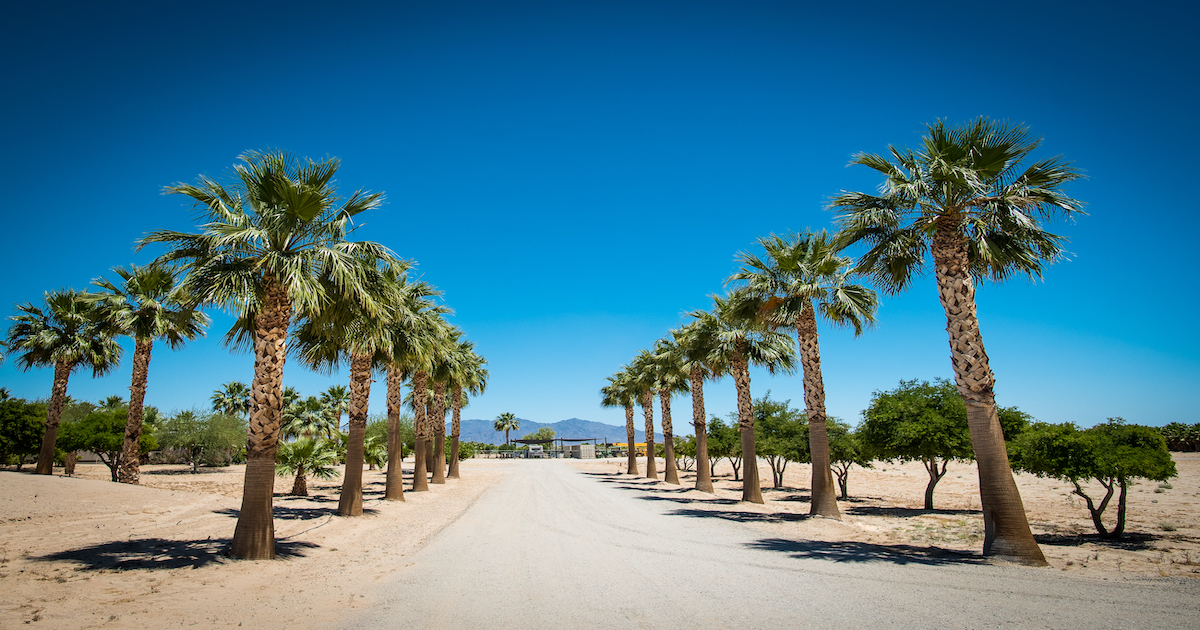
You see these towering, skinny silhouettes lining the Hollywood Walk of Fame and Sunset Boulevard. The Mexican Fan Palm grows faster than its California cousin, adding 3–5 feet of trunk per year under ideal conditions. It handles the marine layer beautifully but also shrugs off inland heat.
Cold tolerance: 20°F (protect young trees below 25°F)
Height: 80–100 feet
Best for: Coastal cities, long driveways, and creating vertical architectural statements.
3. Mediterranean Fan Palm (Chamaerops humilis)
The perfect clumping palm for small spaces.
This is actually a multi-trunked shrubby palm, making it ideal for entryways, courtyards, or container growing. The Mediterranean Fan Palm is incredibly forgiving of poor soil, limited irrigation, and salt spray. Its bluish-green, fan-shaped leaves bring a European Riviera vibe to any property.
Cold tolerance: 10°F
Height: 8–15 feet
Best for: Small gardens, planter boxes, and cold pockets (like Sacramento or Redding).
4. Pindo Palm (Butia capitata)
The “Jelly Palm” with grey-blue feather leaves.
For something completely different, the Pindo Palm offers feather-like fronds and edible fruit used to make jam and wine. It thrives in California’s Central Valley and even handles light snow. Its stout, stocky trunk and weeping canopy create a soft, tropical texture without the water demands of a true tropical palm.
Cold tolerance: 14°F
Height: 15–20 feet
Best for: Edible landscaping, pool areas (litter-free), and suburban front yards.
5. King Palm (Archontophoenix cunninghamiana)
The exception for coastal California.
While most tropical palms fail in California, the King Palm surprisingly succeeds along the immediate coast (zones 10a and 10b) where winter temperatures stay above 28°F. It requires more water than the others, but its smooth green trunk and luxurious feather fronds deliver a real jungle feel.
Cold tolerance: 28°F (must protect below this)
Height: 40–60 feet
Best for: San Diego, Santa Barbara, and Los Angeles coastal neighborhoods.
Planting and Soil Considerations for California Palms
Even the Best Palm Trees for California Climate: Expert Buying Guide cannot save a palm planted in the wrong spot. California clay soils drain poorly, while desert sand drains too fast. Follow these professional protocols from Wholesale Desert Palm:
Amend wisely: Do not put gravel at the bottom of the hole (this creates a perched water table). Instead, mix native soil with 20% coarse sand or pumice.
Dig shallow, not deep: Plant the root ball one inch above ground level. Palms do not have taproots; planting too deep causes trunk rot.
Watering schedule: For the first three months, water every 3–4 days deeply. For months 3–12, reduce to once weekly. After the first year, most California-adapted palms need only bi-weekly deep watering in summer and none in winter rain.
Water Conservation: The California Mandate
With the Colorado River Basin under constant strain, your palm selection directly impacts your water footprint. The Best Palm Trees for California Climate: Expert Buying Guide strongly recommends avoiding water-hungry species like the Bismarck Palm or Royal Palm, which require flood irrigation to look decent. Instead, focus on “dry-adapted” palms that the state’s Department of Water Resources classifies as very low-water users. All the varieties recommended above—with the sole exception of the King Palm—require less annual irrigation than a typical lawn using modern drip systems.
Wholesale Desert Palm offers every specimen pre-conditioned to reduced irrigation. Our nursery uses deficit irrigation techniques (watering only when leaves begin to fold) so that when you take a palm home, it is already drought-hardened.
Common Mistakes to Avoid
When following this Best Palm Trees for California Climate: Expert Buying Guide, steer clear of these costly errors:
Over-pruning (hurricane cutting): Never strip all the green fronds off a California palm. They need those leaves to photosynthesize and build trunk caliper.
Planting tropical species: Avoid Areca Palms, Foxtail Palms, or Coconut Palms. They will die the first time a 35°F night occurs.
Ignoring the microclimate: A hilltop in Riverside gets frost 10 nights per year; a canyon bottom 2 miles away stays frost-free. Map your specific frost pockets.
Buying root-bound specimens: Palms do not like being root-bound. Always purchase from Wholesale Desert Palm, where we up-pot on a strict schedule to maintain healthy root systems.
Maintenance Schedule for California Palms
To keep your landscape looking professional, follow this annual calendar:
Spring (March–April): Apply a slow-release palm fertilizer (8-2-12 with micronutrients). Remove dead fronds and flower stalks.
Summer (June–August): Deep water once every 10–14 days for established palms. Watch for spider mites (common in hot inland valleys).
Fall (September–October): Stop all nitrogen fertilization to prevent winter-sensitive new growth. Apply a layer of mulch (but keep it 6 inches away from the trunk).
Winter (November–February): Only water if we experience a dry spell exceeding 30 days. For young palms, cover the crown with frost cloth if temperatures dip below 25°F.
Where to Buy Quality Palms in California
Not all nurseries are created equal. Big-box stores often sell palms grown in Florida or Hawaii that have zero genetic adaptation to California’s dry air. When you buy from Wholesale Desert Palm, you receive locally grown stock that has never known heavy humidity or daily rain. We offer:
Wholesale pricing for contractors and developers
Retail pickup for homeowners
White-glove delivery within 250 miles of our desert growing fields
One-year establishment guarantee on all California Fan and Mediterranean Fan Palms
Our inventory includes all five species listed in this guide, ranging from 5-gallon starters to 24-inch-box mature specimens over 15 feet tall.
Conclusion
Selecting the right vegetation for the Golden State requires more than just aesthetic preference—it demands horticultural honesty. You need trees that respect the dry summers, respect the winter chills, and respect your water budget. This Best Palm Trees for California Climate: Expert Buying Guide has outlined the top performers: the native California Fan Palm, the soaring Mexican Fan Palm, the compact Mediterranean Fan Palm, the fruit-bearing Pindo Palm, and the coastal King Palm. Each of these species, when properly sited and maintained, will provide decades of architectural beauty with minimal intervention.
Remember the three golden rules: plant high, water deep but infrequently, and never over-prune. For the healthiest, most climate-adapted specimens available, look no further than Wholesale Desert Palm. Our family has been growing palms in California’s toughest environments for three generations. We don’t just sell trees—we guarantee success under the California sun. Visit our nursery or browse our online catalog today to bring the timeless elegance of palms to your landscape. With the right genetics and the right knowledge, your California dream garden is closer than you think.